OVER the Christmas and New Year period many of us will be travelling to visit friends and relatives, or will have visitors to stay. Our normal routines may have to be changed, but any disruption is outweighed by the joy that company brings. This Sunday is all about journeys to visit family. It takes the best part of a week to walk the ninety miles from Nazareth to Bethlehem. This is a difficult journey, which is uphill all the way. The Gospel this morning tells the story of the Visitation, when Mary went to visit her cousin Elizabeth, to help her during her pregnancy. Two expectant mothers together and two journeys to be with family. These journeys form an important part of the Christmas story, and change the world.
What was about to happen in Bethlehem had been announced. The prophet Micah contains one of the great Messianic prophecies:
‘ohonot ti y daw allan i mi un i fod yn llywodraethwr yn Israel, a’i darddiad yn y gorffennol, mewn dyddiau gynt.’
‘from you shall come forth for me one who is to be ruler in Israel, whose coming forth is from of old, from ancient days.’ (Micah 5:2)
Christ’s coming is ordained: He will be Israel’s true king. God’s plan of salvation has always been that Jesus should be born, and all of human history from the Creation onwards has been leading up to this point. Jesus will:
‘Fe arwain y praidd yn nerth yr Arglwydd, ac ym mawredd enw’r Arglwydd ei Dduw. A byddant yn ddiogel, oherwydd bydd ef yn fawr hyd derfynau’r ddaear; ac yna bydd heddwch.’
‘shepherd his flock in the strength of the Lord, in the majesty of the name of the Lord his God. And they shall dwell secure, for now he shall be great to the ends of the earth. And he shall be their peace.’ (Micah 5:4-5a)
Our Lord is the Good Shepherd who cares for His flock and lays down His life for us. We can dwell secure because Christ is our peace, and in Him we have the hope of Heaven and the promise of eternal life. These are huge claims to make, and yet Jesus will fulfil them.
This is why the author of the Letter to the Hebrews can be confident that:
‘â’r ewyllys honno yr ydym wedi ein sancteiddio, trwy gorff Iesu Grist sydd wedi ei offrymu un waith am byth.’
‘by that will we have been sanctified through the offering of the body of Jesus Christ once for all’ (Hebrews 10:10)
The eternal offering of a sinless victim, both frees humanity of its sins, and also restores our relationship with God and with one another. It is an act of perfect obedience: prepared by God for Christ to do His will and sanctify humanity, to heal us and restore us. The Incarnation IS God’s plan for the salvation of humanity, it is not Plan B!
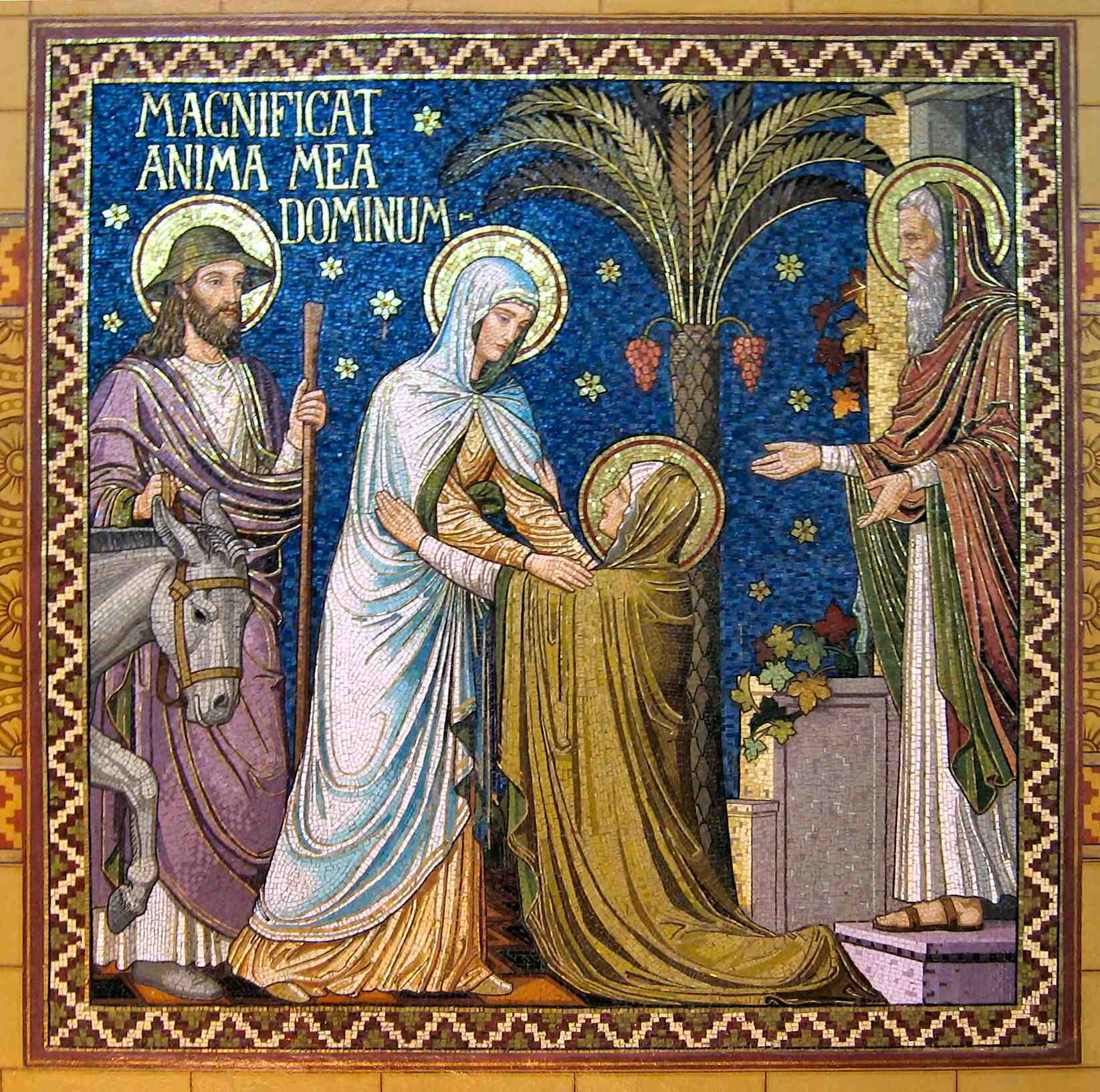
So while Mary, Joseph, and the donkey are making their way to Bethlehem, we turn our eyes elsewhere. The Gospel this morning is St Luke’s account of the Visitation, when Mary goes to see her older cousin Elizabeth, who is pregnant with her son, John the Baptist.
‘Pan glywodd hi gyfarchiad Mair, llamodd y plentyn yn ei chroth’
‘And when Elizabeth heard the greeting of Mary, the baby leaped in her womb.’ (Lk 1:41)
Even before he was born, John recognises Jesus, and leaps for joy, announcing Christ’s presence and preparing His way. This leads Elizabeth to say to Mary:
‘Bendigedig wyt ti ymhlith gwragedd, a bendigedig yw ffrwyth dy groth.’
‘Blessed are you among women, and blessed is the fruit of your womb!’ (Lk 1:42)
Mary is blessed, because she says, ‘Yes’ to God, and she will soon give birth to a baby boy. This is no ordinary child, but God with us, Emmanuel. Elizabeth recognises that Mary’s obedience and humility undoes the sinfulness of Eve. That she who knew no sin might give birth to Him who would save us and all humanity from our sin. It is through the love and obedience of Mary that God’s love and obedience in Christ can be shown to the world. This is demonstrated in absolute perfection when, for love of us, Jesus opens His arms to embrace the world with the healing love of God on the Cross. Mary’s child will grow to be the good Shepherd, laying down his life for His flock, so that we may have life in all its fullness. As Christians, we prepare to celebrate Christmas because it points us to the Cross and beyond, and shows us once and for all, God’s great love for us.
We celebrate Mary because in all things she points to her Son. It is not about her, it is all about Jesus. We honour the Mother of God; and we worship the Son of God. We worship Him who died for love of us and all humankind. Jesus, who gave himself, to die so that we might live. The process of salvation starts with a young woman being greeted by an angel, and saying, ‘Yes’ to God.
Our salvation is very close indeed. We can feel it. We know that God keeps His promises. We can prepare to celebrate this Christmas festival with joy, because we know what is about to happen: a baby will be born who will save humanity from their sins. He is the one whom John the Baptist recognises as the Lamb of God, the one who takes away the sins of the world. This is the Good news we share with the world around us: that God loves us, was born for us, and dies and rises again, for us. Everything: all that Jesus is and says and does — from His taking flesh in the womb of His mother, His Birth, His Life, Death and Resurrection — proclaim God’s love to us. This is what we are preparing to celebrate: God’s love of humanity. Our Heavenly Father has always loved us, and always will. God is love.
Let us therefore prepare to celebrate that love, so that it can fill our hearts and minds, making us into living proclamations of God’s love. God loves us so that we might become lovely, and gave His life for us, so that we may come to share in His life. This is the hope proclaimed by the prophets. This is the hope of Advent. This is our hope! And, as we await Christ’s Coming, let us give praise and honour to God the Father, God the Son, and God the Holy Spirit. To whom be ascribed all glory, dominion and power, now and forever. Amen.
 Novus Motus Oxoniensis