IN the 2003 film Bruce Almighty, Jim Carey’s character, Bruce, feels like his life is falling apart. As he drives in the dark, he begs God to tell him what to do, to give him a sign, or a signal. Immediately, a truck appears in front of him loaded with road signs saying, ‘Wrong way’, ‘Do not enter’, and ‘Stop!’. Bruce ignores the signs, overtakes the truck and then crashes his car into a lamppost. He is not hurt, but he is angry with God for not listening to his peas for guidance. This comedic scene brings home the message that sometimes we ask for God’s help in our lives and then fail to listen to what God is telling us to do.
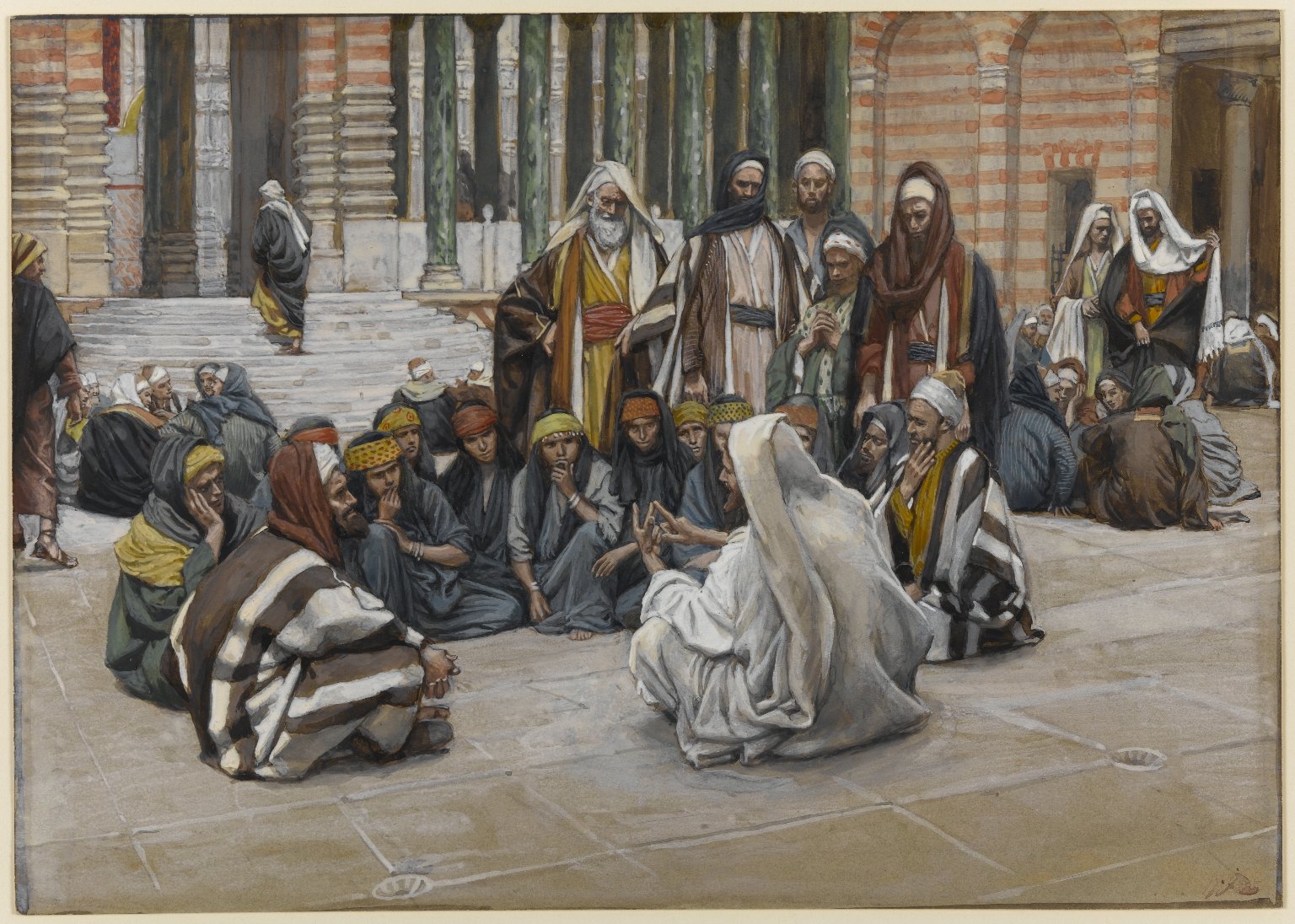
In this morning’s Gospel, Jesus is in Jerusalem, engaging in some theological discussions in the Temple. He has just been talking to a group of Sadducees about the Resurrection. Their conversation gains to the attention of a Scribe, a legal expert, who asks Our Lord:
“Prun yw’r gorchymyn cyntaf o’r cwbl?”
“Which commandment is the most important of all?” (Mk 12:28)
Jesus answers, as we would expect, with words which also form part of this morning’s first reading from Deuteronomy:
“Y cyntaf yw, ‘Gwrando, O Israel, yr Arglwydd ein Duw yw’r unig Arglwydd, a châr yr Arglwydd dy Dduw â’th holl galon ac â’th holl enaid ac â’th holl feddwl ac â’th holl nerth.’”
“The most important is, ‘Hear, O Israel: The Lord our God, the Lord is one. And you shall love the Lord your God with all your heart and with all your soul and with all your mind and with all your strength.’” (Mk 12:29-30)
These words form the Shema, are a prayer recited three times a day by Jews. They are a declaration of faith in God, and represent how each person is called to love God with all of our being. To this Our Lord adds:
“Yr ail yw hwn, ‘Câr dy gymydog fel ti dy hun.’ Nid oes gorchymyn arall mwy na’r rhain.”
“The second is this: ‘You shall love your neighbour as yourself.’ There is no other commandment greater than these.” (Mk 12:31)
Christ quotes from Leviticus (19:18) to show our duty towards our neighbour. Christians are commanded both to love, and to will the good of others, as St Thomas Aquinas said in the Summa Theologiae: ‘Love is to will the good of another, Mae cariad ewyllysio y Dda o’r eraill’. To love, then, is not simply an act of passion or emotion — something which we feel — but it is also something which we choose to do. As followers of Christ, we desire to see others flourish, and we work towards that end. Love takes effort. To choose someone else’s good reminds us that we do not exist for our own sake, and that our lives are lived in community and relationship with others. We are called to be loving and generous, just as God has been loving and generous towards us in Christ. We seek to cooperate with God in promoting human flourishing.
Our Lord’s teaching meets with the Scribe’s approval
“Da y dywedaist, Athro; gwir mai un ydyw ac nad oes Duw arall ond ef. Ac y mae ei garu ef â’r holl galon ac â’r holl ddeall ac â’r holl nerth, a charu dy gymydog fel ti dy hun, yn rhagorach na’r holl boethoffrymau a’r aberthau.”
“You are right, Teacher. You have truly said that he is one, and there is no other besides him. And to love him with all the heart and with all the understanding and with all the strength, and to love one’s neighbour as oneself, is much more than all whole burnt offerings and sacrifices.” (Mk 12:32-33)
Our duty towards God and our neighbour — namely to love them — is foundational to how we practise our religion and how we live our lives. This responsibility informs all that we are, and all that we do, and also promotes human flourishing. The scribe recognises this, and rather than tying to catch Jesus out, he is genuinely interested in seeing the world become a better place.
Such a positive response elicits a similar one from Jesus:
A phan welodd Iesu ei fod wedi ateb yn feddylgar, dywedodd wrtho, “Nid wyt ymhell oddi wrth deyrnas Dduw.”
And when Jesus saw that he answered wisely, he said to him, “You are not far from the kingdom of God.” (Mk 12: 34)
The scribe is not far from following the signs and becoming a follower of ‘The Way’. However, while he agrees with Jesus’ teaching, the scribe still does not recognise Jesus as the Messiah, which Bartimaeus, in last Sunday’s Gospel, was able to do despite being blind.
As Christians we believe that Jesus is our great high priest, who gives Himself, on our behalf, as an offering to God the Father, out of love. This is what takes place on the Cross at Calvary. God, in Christ, gives everything. The life of the Son of God is offered freely, to reconcile what sin has thrust apart. Jesus is the greatest example of generosity that exists. This is the heart of the Christian Faith: Christ dies for us and rises again to heal the wounds of sin and division and to open up the way to Heaven for those who believe in Him. At its heart the message of the Gospel is love: love of God and neighbour. This is what Our Lord demonstrates on the Cross. The greatest expression of God’s love for humanity, which is made present in the Eucharist. Each and every time the Eucharist is celebrated, we, the people of God, are fed with Christ’s Body and Blood, to be built up in love. The love of God becomes something which we can touch and taste. Jesus gives Himself to us, so that we can grow in the love of God and of each other.
So my brothers and sisters in Christ, let us be nourished by Him in Word and Sacrament. Let us be filled with the love of God and love of our neighbours, so that this love forms who we are and what we do. Let us also give praise and honour to God the Father, God the Son, and God the Holy Spirit. To whom be ascribed all glory, dominion and power, now and forever. Amen.
 Novus Motus Oxoniensis