There are, as we all know, few things in life worse than when someone we love is seriously ill. We do everything we possibly can to help, but often there is not much that we can do. However, when we feel powerless and desperate, and need help, we can turn to God in prayer. The Kingdom of God, proclaimed and inaugurated by Jesus Christ is a place of true healing, and through our relationship with Jesus we can seek wholeness for ourselves and for those close to us. This is why the Gospels contain healing miracles. These miraculous accounts are signs of God’s restoration of creation through His Son, something which will culminate with Christ’s Passion, Death, and Resurrection, and through which our human nature is healed.
In today’s Gospel Jesus and the disciples have sailed back across the Sea of Galilee to the Jewish side. On their arrival they are greeted by the leader of a local synagogue whose daughter is close to death. Jairus longs for his child to be healed, and asked Jesus to place His hands on her, so that she might be saved and live.
While Jesus is walking to Jairus’ house to heal his daughter, another miracle takes place. Lots of people are following, which is understandable since Jesus is a charismatic preacher and teacher, who heals people. In the crowd is a woman with a serious gynaecological complaint. Two people need healing, and while Our Lord is on His way to heal one female in need, another seizes the opportunity to be cured.
This woman is desperate, because she has suffered bleeding for twelve years. In Jewish ritual terms she would be classed as unclean. She would have been unable to join in worship, and would be seen as someone to avoid. Also, she would not have been able to bear children. Despite all her efforts and attempts to find a cure she had only got worse, even though she had spent all the money she possessed. The presence of this miraculous healer was the answer to her prayers. She had heard about the Saviour, and said to herself:
“If I touch even his garments, I will be made well.”
“Os cyffyrddaf hyd yn oed â’i ddillad ef, fe gaf fy iacháu.” (Mk 5:28)
This woman has faith. She believes that Jesus can heal her, and she puts her trust in Him to do what the physicians could not achieve. Our Lord notices that someone has touched His garments. He realizes that this was not simply someone brushing past, but something important. His disciples, not aware of what has happened, try to put this down to the press of the crowd. Then the woman, who has been healed, comes forward:
‘But the woman, knowing what had happened to her, came in fear and trembling and fell down before him and told him the whole truth. And he said to her, “Daughter, your faith has made you well; go in peace, and be healed of your disease.”’
‘Daeth y wraig, dan grynu yn ei braw, yn gwybod beth oedd wedi digwydd iddi, a syrthiodd o’i flaen ef a dweud wrtho’r holl wir. Dywedodd yntau wrthi hi, “Ferch, y mae dy ffydd wedi dy iacháu di. Dos mewn tangnefedd, a bydd iach o’th glwyf.”’ (Mk 5:33-34)
The woman comes ‘in fear and trembling’ not because she is afraid of Jesus, but because it is the proper way for humans to act in the presence of God. She is filled with awe at her experience of divine healing. Jesus’ reply is astounding for several reasons. The fact that He responds at all is noteworthy. Talking to a woman who was not a member of your family was frowned upon, let alone a woman who is viewed as being ritually unclean and an outcast. Jesus is breaking a social taboo. He also addresses her as ‘daughter’, a reminder that Jesus’ family are not just those related to Him in earthly terms, but all those who do God’s will. This unnamed woman is a daughter of God and her faith has healed her. She trusted God to do what the physicians could not. Faith is the route to salvation and healing, by trusting God to be at work. Now the woman can go in peace, because she has been restored to health. Peace is God’s gift to us, that we may experience wholeness. Jesus underlines that what has happened is not a temporary healing, but a permanent state of affairs.
While Jesus is still speaking to the woman, messengers come to give Jairus some bad news:
“Your daughter is dead. Why trouble the Teacher any further?”
“Y mae dy ferch wedi marw; pam yr wyt yn poeni’r Athro bellach?” (Mk 5:35)
The situation is hopeless, and in their eyes there is nothing that Jesus can do. Thankfully, Our Lord has other ideas:
‘But overhearing what they said, Jesus said to the ruler of the synagogue, “Do not fear, only believe.”’
‘Ond anwybyddodd Iesu y neges, a dywedodd wrth arweinydd y synagog, “Paid ag ofni, dim ond credu.”’ (Mk 5:36)
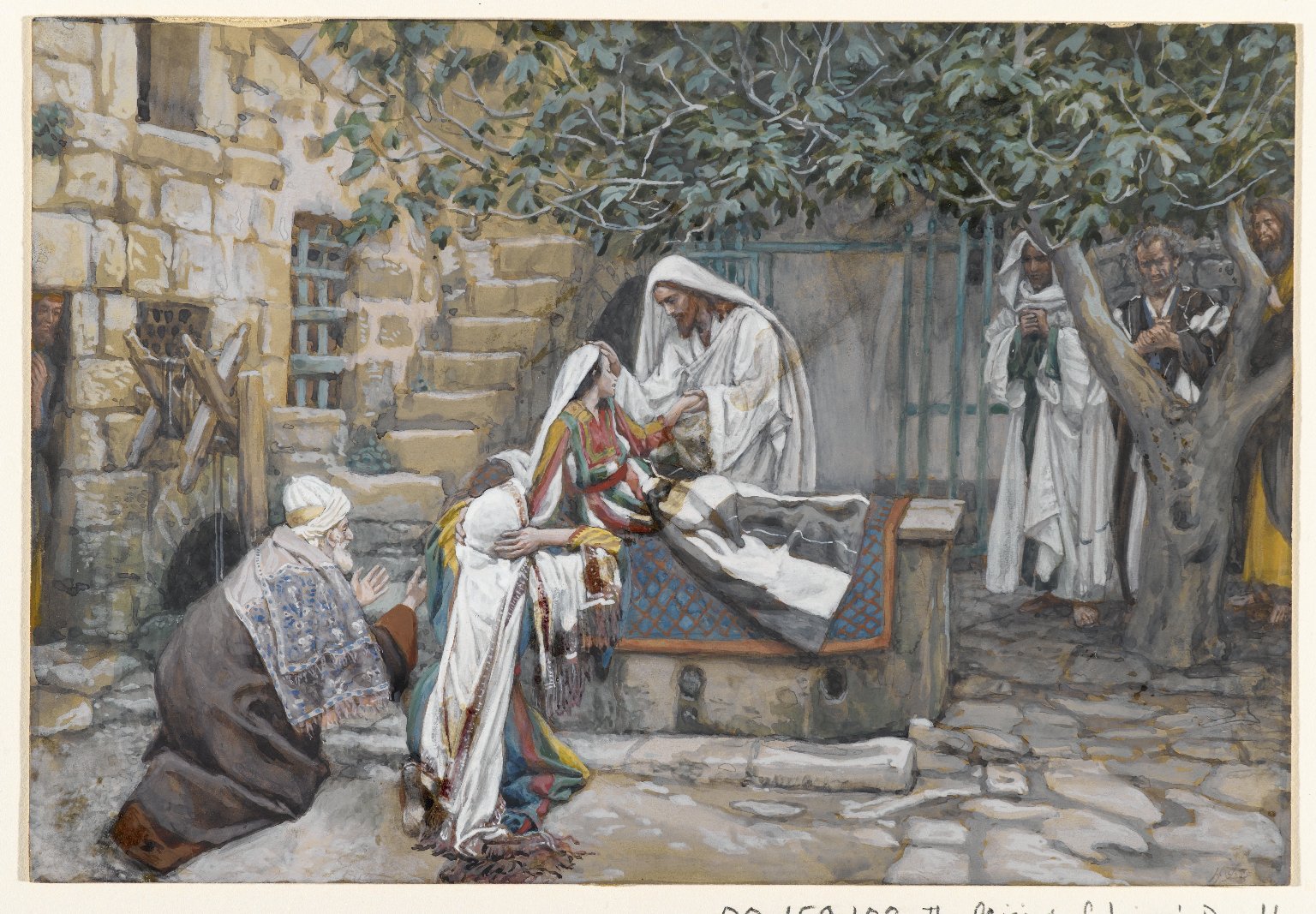
Instead of being afraid Jairus needs to believe that God will save his daughter. The synagogue leader has already demonstrated his faith by prostrating himself before Jesus and asking for healing. Now, in the face of his daughter’s apparent demise, Jairus must trust God to be at work. When Jesus arrives at the house a second miracle takes place:
‘Taking her by the hand he said to her, “Talitha cumi”, which means, “Little girl, I say to you, arise.”’
‘Ac wedi gafael yn llaw’r plentyn dyma fe’n dweud wrthi, “Talitha cŵm,” sy’n golygu, “Fy ngeneth, rwy’n dweud wrthyt, cod.”’ (Mk 5:41)
Note the fact that Jesus takes the girl by the hand. AT the time of Jesus, touching a dead body would make a person ritually impure. This is why the priest and Levite in the Parable of the good Samaritan pass by on the other side, for fear of being made unclean by being in contact with a dead person. Jesus disregards the taboo of uncleanness, and speaks to the girl. He addresses her in Aramaic, her mother tongue, and says “Talitha cumi” literally: ‘little lamb, get up’ ‘oen bach codwch’. This is a term of endearment which also reminds us that Christ is the Good Shepherd who cares for His lambs, keeping them safe, and saving them from death.
The people who are present — Jairus and his wife, Peter, James and John — are all amazed. They are filled with awe, with holy fear at witnessing the mighty works of God. Finally, Jesus tells her parents to give the girl something to eat, which shows us the reality of her resuscitation. This also points towards the feast of the Kingdom, which we hope to enjoy in Heaven, and which is prefigured in the Eucharist. In physical and spiritual communion, Christ gives Himself to feed us. Through His Body and Blood He heals our bodies and our souls, and assures us of eternal life.
As we care for and pray for those close to us who are ill we give thanks that God loves us, and heals us. Through faith, wonderful things can, and do, happen. May our worship today be a foretaste of Heaven, where all are healed. Let us join with Saints and Angels to sing the praises of God the Father, God the Son, and God the Holy Spirit. To whom be ascribed all glory, dominion, and power, now and forever. Amen.
 Novus Motus Oxoniensis