THIS morning many of us will have opened door №17 on our Advent Calendars. The Countdown to Christmas is well underway and seems to be moving even more quickly this year when Advent is only 3 weeks and 1 day long. There is much to prepare for. Most importantly, as Christians, we joyfully prepare to meet Jesus, both as a baby born in Bethlehem, and as our Saviour and our Judge. During this season our readings focus on both the prophet Isaiah and John the Baptist. This is because they both look to Jesus, as the fulfilment of prophecy: the Messiah, God’s anointed, who will save God’s people from their sins.
In the Gospels, the religious authorities, the Scribes, Pharisees, and priests, tend to receive a fairly negative portrayal. Much of this is for good reason, but, this morning, I have to admit that I find myself agreeing with their questioning. The Gospel passage set for today takes two passages from the first chapter of St John’s Gospel. The first is quite straightforward. The evangelist writes:
There was a man sent from God, whose name was John. He came as a witness, to bear witness about the light, that all might believe through him. He was not the light, but came to bear witness about the light.
Yr ydoedd gŵr wedi ei anfon oddi wrth Dduw, a’i enw Ioan. Hwn a ddaeth yn dystiolaeth, fel y tystiolaethai am y Goleuni, fel y credai pawb trwyddo ef. Nid efe oedd y Goleuni, eithr efe a anfonasid fel y tystiolaethai am y Goleuni. (Jn 1:6-8)
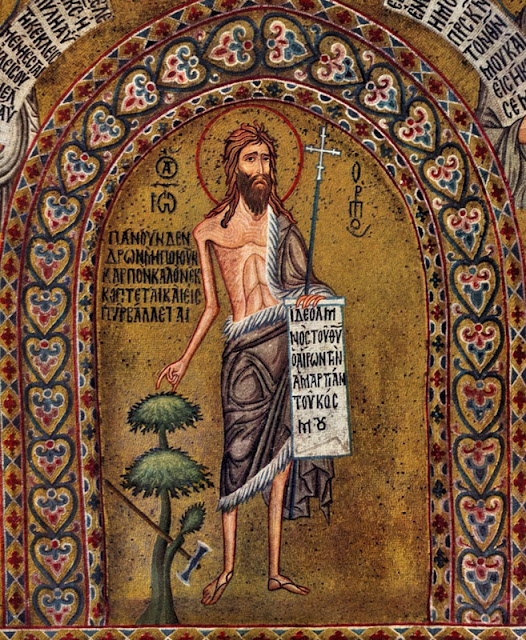
John the Baptist is the forerunner, the one who comes to bear witness to Christ, the Light of the World. He proclaims the Good News of God’s Kingdom by calling people to repentance. John calls us all to turn away from our sins, and to turn back to the God who loves us, and will save us. Today’s Gospel then shifts to the interaction between John and representatives from the Temple in Jerusalem:
And this is the testimony of John, when the Jews sent priests and Levites from Jerusalem to ask him, “Who are you?”
A hon yw tystiolaeth Ioan, pan anfonodd yr Iddewon o Jerwsalem offeiriaid a Lefiaid i ofyn iddo, Pwy wyt ti? (Jn 1:19)
At one level John’s response to this question could have been purely factual: ‘I am John, the son of Zechariah the priest’. John would have known Temple priests, being the son of one, and they in turn would have known him. The priests and Levites are interested both in John’s identity and in what he is doing.
As we heard last week, John has been baptising people in the Jordan. He stationed himself near Bethany where the road from Jerusalem to Jericho meets the Jordan. It is somewhere where you can cross the river, the water is shallow, you and your animals can drink and rest. It is an ideal place to have a break — the first-century equivalent of a motorway service station. John has been preaching repentance, and he has washed people in flowing water, to signify forgiveness. The religious authorities are trying to understand what exactly is going on. The conversation continues:
He confessed, and did not deny, but confessed, “I am not the Christ.” And they asked him, “What then? Are you Elijah?” He said, “I am not.” “Are you the Prophet?” And he answered, “No.”
Ac efe a gyffesodd, ac ni wadodd; a chyffesodd, Nid myfi yw’r Crist. A hwy a ofynasant iddo, Beth ynteu? Ai Eleias wyt ti? Yntau a ddywedodd, Nage. Ai’r Proffwyd wyt ti? Ac efe a atebodd, Nage. (Jn 1:20-21)
John’s answer is clear. He is neither the Messiah, nor is he Elijah — though he does look somewhat like him. Those questioning the Baptist ask him to explain himself, so that they can tell the religious authorities in Jerusalem who and what he is. In answer John quotes from the Fortieth Chapter of Isaiah, which we heard read last week.
He said, “I am the voice of one crying out in the wilderness, ‘Make straight the way of the Lord’, as the prophet Isaiah said.”
Eb efe, Myfi yw llef un yn gweiddi yn y diffeithwch, Unionwch ffordd yr Arglwydd, fel y dywedodd Eseias y proffwyd. (Jn 1:23)
While this might appear a slightly cryptic response, what John is saying is: ‘I am fulfilling Isaiah’s prophecy’, in other words: ‘the Messiah is coming!’ This is Good News. It is also the reason why today’s reading from the prophet Isaiah contains the very passage that Jesus reads out in the synagogue at Nazareth at the start of his public ministry (Lk 4:16-19). John the forerunner proclaims that the Messiah is coming, this is a reason to be joyful!
The priests and Levites cannot quite understand what is going on. If John the Baptist is not the Messiah, nor Elijah returned to earth, why then is he baptising people?
John answered them, “I baptize with water, but among you stands one you do not know, even he who comes after me, the strap of whose sandal I am not worthy to untie.”
Ioan a atebodd iddynt, gan ddywedyd, Myfi sydd yn bedyddio â dwfr; ond y mae un yn sefyll yn eich plith chwi yr hwn nid adwaenoch chwi: Efe yw’r hwn sydd yn dyfod ar fy ôl i, yr hwn a aeth o’m blaen i; yr hwn nid ydwyf fi deilwng i ddatod carrai ei esgid.(Jn 1:26-27)
John sees himself as not even worthy to untie his cousin Jesus’ sandals, something that a servant would do. He is a model of humility. The Baptist does not seek power or prestige, all he wants is to do is God’s will. Christ is unknown to the religious authorities, and to all who do not follow Him. But we know Him and love Him, as Our Lord and Saviour, and we wait for His coming filled with joy and expectation.
Even in the depth of winter, we know that God is someone whom we can trust, who keeps His promises. Our Heavenly Father offers the world the greatest present we could ever hope for: true love and eternal life. Today, the peace which the Messiah came to bring seems as elusive as ever, with the human capacity to create misery in the most dreadful ways continuing relentlessly. We know that humanity still has some considerable distance to travel. One possible answer is to embrace the need for repentance: to change our hearts and minds and to follow Christ. We also prepare to meet Him as He will come again, as our Saviour and our Judge. It is a daunting prospect, yet we know and trust that Jesus saves us. By His Wounds on the Cross we are healed, our sins are forgiven.
As Christ’s followers we rejoice in a God who loves us, who heals us, and who and restores us. In Him, and through Him, we are given real hope for the future. In the midst of human pain and sorrow we can place all our hope and trust in God, who both loves us, and saves us. We draw close to Jesus in His Word, and in the Sacrament of the Altar. Today we are fed with His Body and Blood, so that we can be sanctified by God, and share in his divine life and joy.
Like Jesus and John the Baptist, may we be filled with the Holy Spirit. Let us proclaim God’s Truth so that all the world may come to believe and trust in Him. May we, this Advent time and always, sing the praises of God the Father, God the Son, and God the Holy Spirit. To whom be ascribed all glory, dominion, and power, now and forever. Amen.
 Novus Motus Oxoniensis