SOMETIMES people ask loaded questions, in order to trap us into saying something unfortunate. If someone were to ask you, ‘Have you stopped cheating your taxes?’ answering either ‘Yes’ or ‘No’ would provide evidence that you had previously, or were continuing to defraud His Majesty’s Revenue. The way to reply is to say, ‘I have never cheated’.
In today’s Gospel the Pharisees attempt to catch Jesus out in a similar way. They begin by seemingly flattering Our Lord:
“Teacher, we know that you are true and teach the way of God truthfully, and you do not care about anyone’s opinion, for you are not swayed by appearances.” (Mt 22: 16)
While their words appear to be complimenting Christ, they are simply trying to lull Him into a false sense of security. Next comes the important question:
“Tell us, then, what you think. Is it lawful to pay taxes to Caesar, or not?” (Mt 22: 17)
The Pharisees want to trap Jesus. If He says ‘Yes’ He appears to be supporting the Romans. This can then be used to cast doubt on His credibility, and write him off as a collaborator: He is not one of us, He is not a real prophet, a true son of Israel. If Jesus comes out against taxation they can brand Him a political troublemaker, a revolutionary, an enemy of the State. By saying ‘No’ Jesus would ally with zealots, religious extremists, and have made a provocative political statement for which He can be denounced.
Thankfully, Our Lord is wise to their tricks:
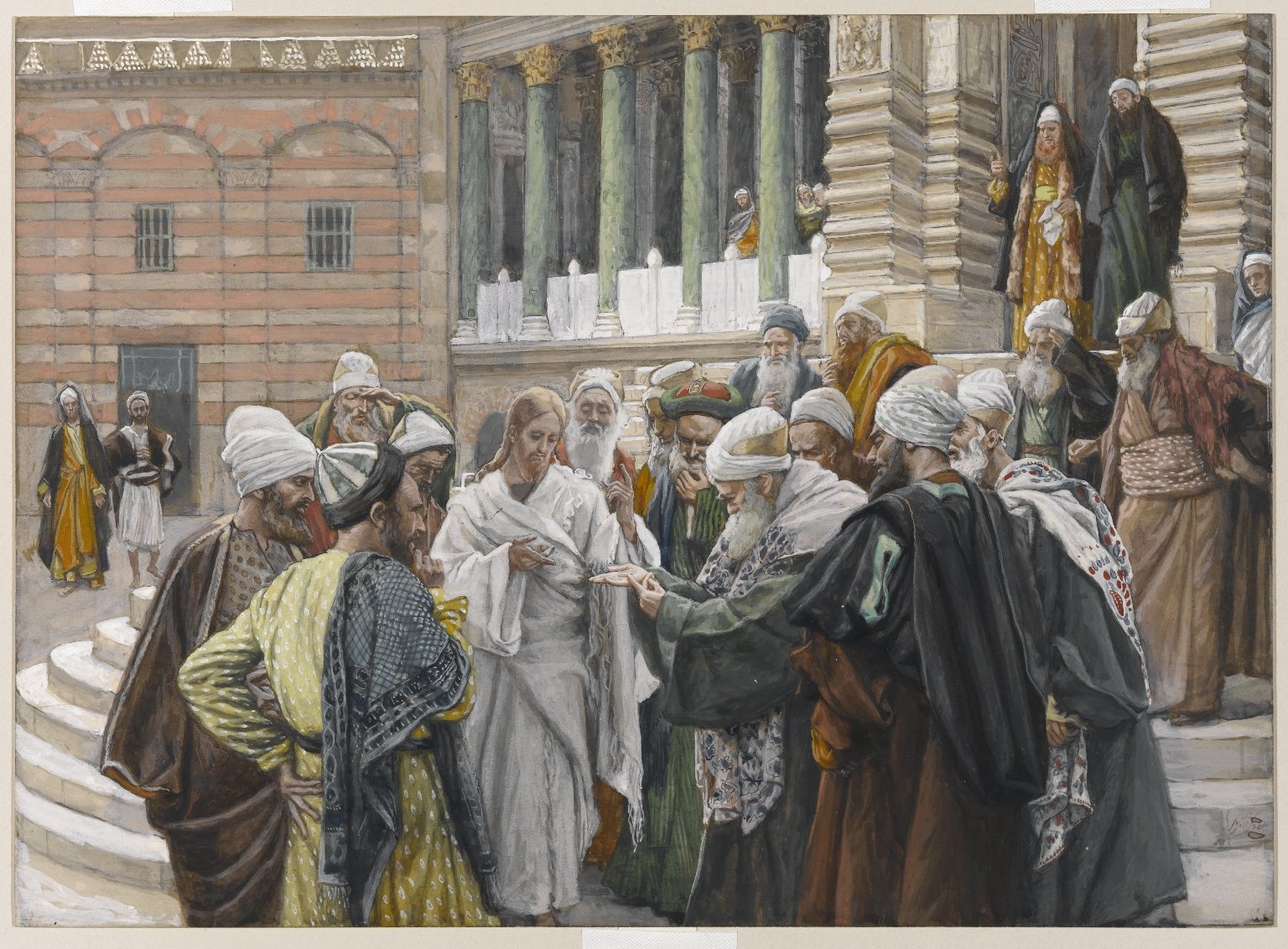
‘But Jesus, aware of their malice, said, “Why put me to the test, you hypocrites? Show me the coin for the tax.” And they brought him a denarius.’ (Mt 22:18-19)
Jesus sidesteps the loaded question by asking to see the coin used to pay tax to the Romans. A denarius is a small silver coin, ¾ of an inch in diameter, about the size of a modern 5p. It represented a day’s wages for a labourer, and worth approximately £75 in today’s money.
‘And Jesus said to them, “Whose likeness and inscription is this?” They said, “Caesar’s.” Then he said to them, “Therefore render to Caesar the things that are Caesar’s, and to God the things that are God’s.” When they heard it, they marvelled. And they left him and went away.’ (Mt 22:19-22)
The Pharisees come filled with malice, with a desire to catch Him out, but Jesus uses this as an opportunity to show them the proper order of things. You should pay your taxes but at the same time give God what is owed to him. That is a heart filled with love, love of God and of each other, a life which proclaims this love in the service of others and through the worship of Almighty God. This is where real power lies. This is the truly subversive aspect of Jesus’ teaching. This is what He proclaims in the Temple, in the very heart of the religious establishment. Christ shows people how to live life to the full.
Jesus does not allow Himself to be drawn into the argument about whether it is idolatrous to use Roman coins with pictures of pagan gods on them. Paying a Roman tax with a Roman coin is fine, but what matters more is rendering to God the things that are God’s.
Jesus is asking us all a difficult question. What do you and I, all of us, render to God ‘talwch i Dduw’ in our personal lives? If we claim to be disciples, then what does that actually mean in the way we speak and act? The Pharisees walk away from Jesus in amazement, but we cannot do that. We have to follow a different set of rules, which give us lives of freedom. In the power of the Holy Spirit the Truth can be proclaimed, the truth which sets us free from the ways of the world, free to love and serve God. Jesus is opposed to either the collaboration of the Herodians or the rigourist harshness of the Pharisees, and instead proclaims the freedom and love of the Kingdom of God. Because of what God has done for us, we are able to render to God the things that are God’s ‘talwch bethau Duw i Dduw’: lives characterised by the love and generosity which are at the heart of the Gospel. This is what really matters: living the life of the Kingdom here and now.
Loving God and loving our neighbour mean living in a way which leads us to thrive both as individuals and as a group of people. It involves turning our backs on the selfishness which surrounds us, and building a genuine community, like that founded by St Paul in Thessalonica in northern Greece. Everything we are, everything we have comes from God, and our primary allegiance is to Him. Christ demonstrates this by going to the Cross for us and all humanity: to demonstrate once and for all how much God loves the world, and longs to heal our wounds and reconcile us to each other and to Him. As we are nourished today by Jesus in Word and Sacrament, may we be built up and strengthened to live out our faith and to proclaim the reality of the Kingdom of God. May we invite others, that all may come to share in the fellowship of the feast and sing the praises of God the Father, God the Son, and God the Holy Spirit. To whom be ascribed all glory, dominion, and power, now and forever. Amen.
 Novus Motus Oxoniensis