THE American statesman, Benjamin Franklin is usually credited as the author of the phrase, ‘but in this world nothing can be said to be certain, except death and taxes.’ Taxation is one of life’s certainties. But if we are honest, most of us don’t really like paying taxes even though we know that we have to, and that life would be miserable if we didn’t. In the Ancient World taxation was privatised, and people would bid for contracts that were auctioned off to the highest bidder. In order to recoup the cost of getting the contract in the first place, people would be overcharged so that the tax collectors would not be out of pocket. It sounds harsh and cruel, and it explains why tax-collectors are generally looked down on in the Israel of Our Lord’s day. People disliked the Roman conquerors, and they disliked their taxes even more, knowing that part of what they paid was simply repaying a bribe.
So when Jesus comes across Matthew the tax-collector, he is a hated figure. Nonetheless Jesus calls him:
‘and he said to him, “Follow me.” And he rose and followed him.’ (Mt 9:9)
The whole scene is over in a few words. Matthew leaves everything and follows Jesus. It’s quite matter of fact, but his whole life changes in this brief encounter. Matthew is someone on the margins, a despised figure, not part of polite society, and yet he is called to be close to Jesus, and to play his part in sharing the Good News of the Kingdom of God. In a society where social respectability is important, Our Lord turns these expectations on their head.
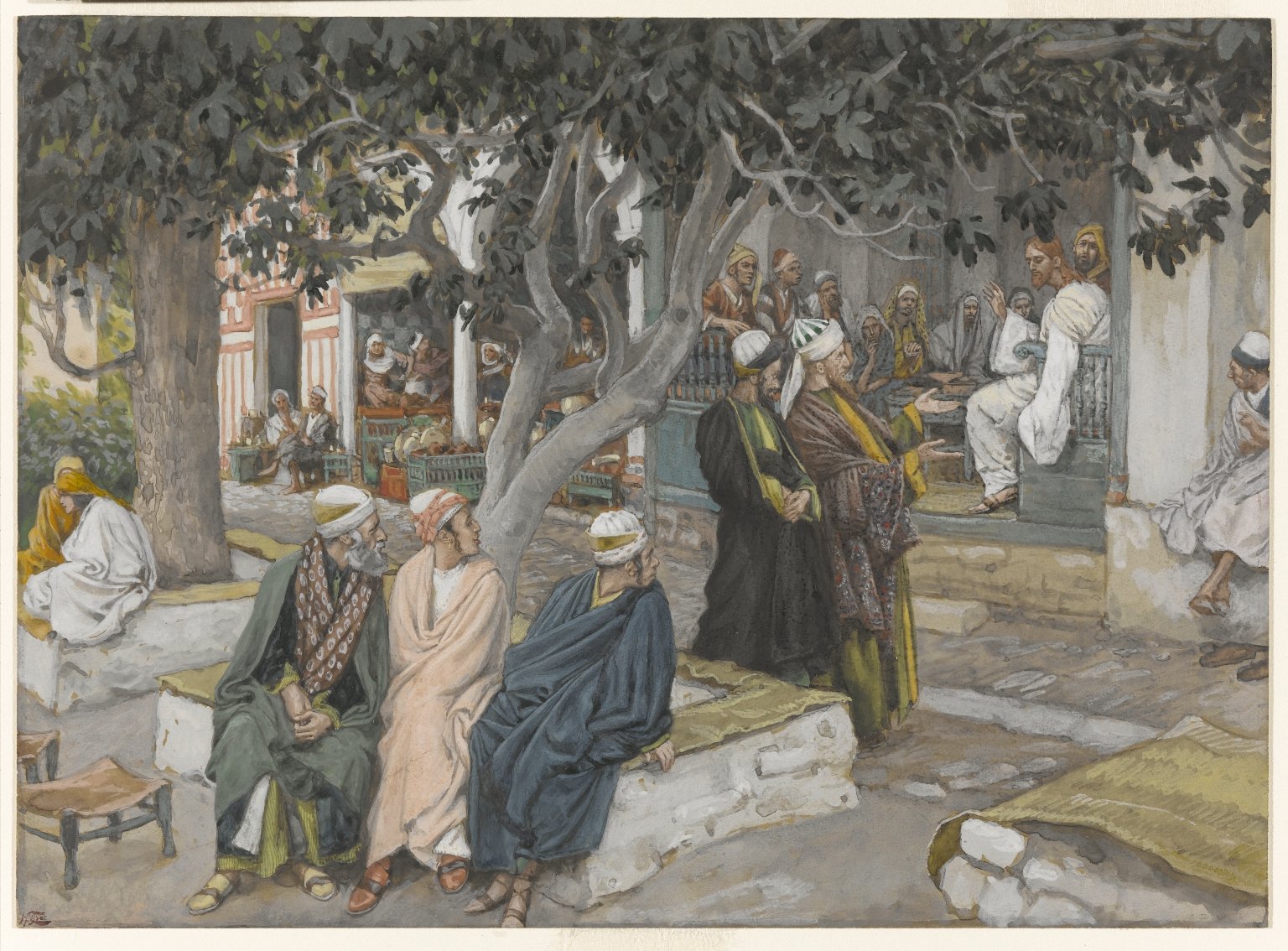
And as Jesus reclined at table in the house, behold, many tax collectors and sinners came and were reclining with Jesus and his disciples. And when the Pharisees saw this, they said to his disciples, “Why does your teacher eat with tax collectors and sinners?” (Mt 9:10-11)
The religious authorities, the Pharisees who are responsible for interpreting and teaching Jewish law are deeply unhappy with what Jesus is doing. He’s hanging round with the wrong sort of people! People who are ritually impure, people who should be shunned.
But when he heard it, he said, “Those who are well have no need of a physician, but those who are sick. Go and learn what this means, ‘I desire mercy, and not sacrifice.’ For I came not to call the righteous, but sinners.” (Mt 9:12-13)
Our Lord is opposed to the self-righteous and judgmental attitude of the Pharisees. Jesus is the Divine Physician who has come to heal our wounds, and to restore our relationship with God and each other. Christ accomplishes this at Calvary, where he offers Himself as both Priest and Victim on the altar of the Cross. Jesus quotes from the Old Testament, in particular Hosea 6:6, which is also the first reading today. God desires mercy, steadfast love. On the Cross, God will demonstrate both mercy, and the sacrifice which ends sacrifice: where God offers Himself for love of us.
Jesus has already pointed out that only people who are sick need physicians. All of us need what Christ offers us. Jesus has not come to call the righteous but sinners: people who fall short of what God wants. The Pharisees, on the other hand, think that they are righteous because they follow the Law of Moses. This makes them self-righteous at best. They too are sinners, just like the tax-collectors and other people dining with Jesus, but they cannot see it. They are afflicted with a spiritual blindness and pride which, in turn, dulls their relationship with God.
The pharisees are judgemental. They think that they are better than someone else. It is a common human failing, which all of us can and do fall into. It leads us to think that we are better than we are, and ultimately to rely upon ourselves rather than God. Sinners, however, know their need of God. This is why they are close to Jesus, eating and drinking with Him. Our Lord is merciful towards them, and through this mercy they are able to begin the process of turning their lives around.
In today’s second reading, Paul is reflecting on the example of Abraham, as a man of faith, who does not doubt that God will keep His promises. Here we see a model for living the Christian life — trusting God. God calls us all to follow Him, and we do so knowing that we are loved by God.
While we are used to images of the Messiah, the anointed saviour of Israel as something of a Davidic superman, bringing peace and freedom from tyranny. It is important to remember that this is not the only image to be found in the Judaeo-Christian tradition. In the tractate Sanhedrin in the Talmud, a discussion of the legal system, we find the following story:
Rabbi Yoshua ben Levi came upon Elijah the prophet while he was standing at the entrance of Rabbi Simeron ben Yohai’s cave … He asked Elijah ‘When will the Messiah come?’ Elijah replied, ‘Go and ask him yourself.’ ‘Where is he?’ ‘Sitting at the gates of the city.’ ‘How shall I know him?’ ‘He is sitting among the poor covered with wounds. The others unbind all their wounds at the same time and then bind them up again. But he unbinds one at a time and binds it up again, saying to himself, ‘Perhaps I shall be needed: if so I must always be ready so as not to delay for a moment.’
While we are used to talking about a broken humanity, one whose wounds need healing, it is all too easy to forget that God shows us vulnerability in being born as a baby in Bethlehem, someone who needs to be cared for and nurtured. In His Passion Our Lord receives 39 lashes and the wounds to His hands, feet and side. When Jesus appears to Thomas, He shows them to him. Having ascended to heaven Christ still bears these marks, so that as the King and Judge of all, He still bears the wounds of love.
In the Incarnation, God became what we are so that we might become what He is. Unlike ordinary food, which when we eat it, becomes part of us, we eat the Body and drink the Blood of Christ so that we might become what He is. We are fed at His table with Himself in order to become the community of God’s love in the world. We share in His life, and share that life with others, as a foretaste of the life to come, in heaven, where that love will be poured out upon us forever.
Ours is a generous God, who does not even spare His Son. God gives Himself for us gladly. This generous and loving nature is shown most fully when we are fed with the Body and Blood of Christ, God’s very self. Given to heal us, so that we may sing the praises of God the Father, God the Son, and God the Holy Spirit. To whom be ascribed all, glory, dominion, and power, now and forever. Amen.
 Novus Motus Oxoniensis