Here in Great Britain we are used to celebrating Harvest Festivals in the Autumn, at the end of the Harvest, but that was not the case in Israel. Fifty days after the Passover, Jews celebrate the first of two Harvest festivals: Shavuot, the Feast of Weeks, or First-fruits. This festival also celebrates the giving of the Law to Moses on Mount Sinai, that we know as the Ten Commandments. There were offerings made of the first-fruits of the Harvest at the Temple in Jerusalem. It was one of the highlights of the year, and one of the great pilgrim festivals. People would travel from all over the Mediterranean World to Jerusalem to worship together. So the fact that the Apostles preach the Good News to:
‘Parthians and Medes and Elamites and residents of Mesopotamia, Judea and Cappadocia, Pontus and Asia, Phrygia and Pamphylia, Egypt and the parts of Libya belonging to Cyrene, and visitors from Rome, both Jews and proselytes, Cretans and Arabians’ (Acts 2:9-11)
makes a great deal of sense. Pentecost was an international event. In Genesis 11:1-9 we see the division of humanity after the Tower of Babel. Here, suddenly, the division of language is removed and the words of the apostles (used to speaking in Greek or Aramaic) could be understood by people of many diverse tongues. Now humanity is united in Christ through the gift of the Holy Spirit. That which was divided has been reconciled.
Today’s Gospel takes us back to St John’s account of Jesus’ appearance to the disciples at Easter. The disciples are afraid: they fear being lynched by a mob for following Our Lord. And suddenly, into the midst of this place of fear and apprehension comes their Saviour:
Jesus came and stood among them and said to them, “Peace be with you.” (Jn 20: 19)
Christ’s gift to His disciples is peace, tangnefedd, the Peace of God. This is something that we all long for in the deepest core of our being, in our soul. God gives us what we truly desire more than anything, except Him. You cannot buy it, or earn it, it comes as a gift, freely given to those who believe in the Lord.
When he had said this, he showed them his hands and his side. Then the disciples were glad when they saw the Lord. (Jn 20:20)
Jesus shows the disciples the wounds of love in His hands and side. His wounds show them who He is, and that He is alive, and that these wounds are the reason that we can have peace. Because of Christ’s death on the Cross, we have access to the internal tranquility we long for. Our Lord’s presence brings not only peace, but also joy. The disciples are glad. Christ gladdens our hearts in a variety of ways: by the gift of the Holy Spirit, and by the gift of Himself in Holy Communion. When we feed on Him, we become what He is.
Having revealed Himself to His disciples, and having filled them with joy and peace, Our Lord commissions the Apostles. They are sent out to proclaim the Kingdom of God:
Jesus said to them again, “Peace be with you. As the Father has sent me, even so I am sending you.” (Jn 20: 21)
God the Father sends the Son to announce the Kingdom and to invite people to ‘Repent and believe the Good News’. The disciples are similarly sent out. At this point they become Apostles, from the Greek word apostolos meaning ‘someone sent out’. They are now given a prophetic role, proclaiming who Christ is, and what He has done, for love of us. Hand in hand with this task goes a ministry of reconciliation, healing wounded souls, restoring what sin has broken:
And when he had said this, he breathed on them and said to them, “Receive the Holy Spirit. If you forgive the sins of any, they are forgiven them; if you withhold forgiveness from any, it is withheld.” (Jn 20:22-23)
The Father sends the Son into the world to heal it, to reconcile humanity to itself and to the Divine. In St John’s account, Easter and Pentecost become a single moment, stressing their intimate connection. Christ dies for us, is raised from the dead, and sends the Holy Spirit, so that humanity can be offered life in all its fullness forever. At this point in the Christian year we focus on how God wants us to love Him and each other. Love is who God is, Father, Son, and Holy Spirit. We see God’s love in the entirety of Jesus’ Life, Death, Resurrection, and Ascension. All that Jesus is and does is a demonstration, a manifestation of God’s love for us. God longs to give us His love, so that it can transform us into His likeness, the likeness in which we were created, so that we might become children of God and heirs, to our inheritance of Heaven.
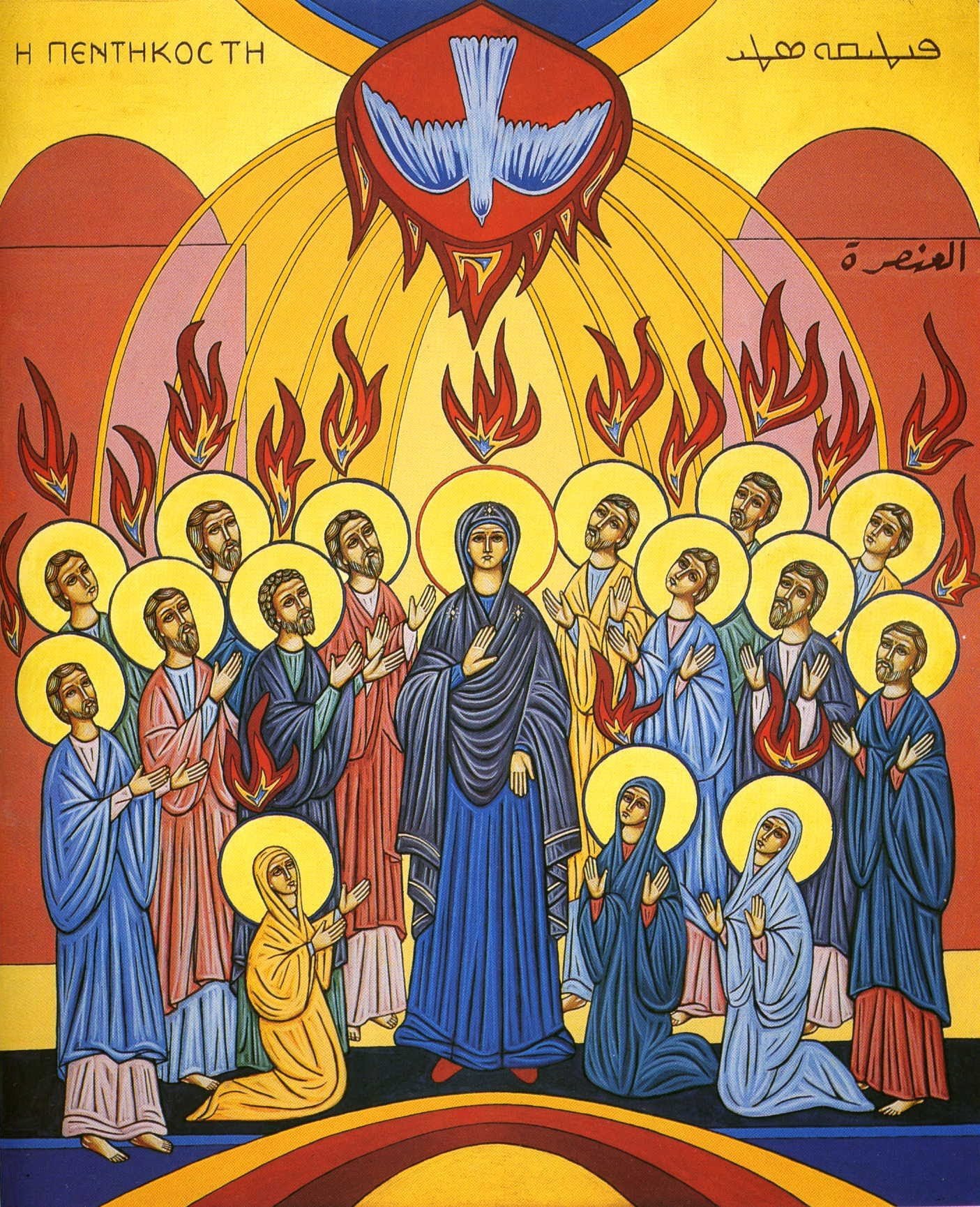
On the day of Pentecost something wonderful takes place: The Good News is proclaimed in a host of different languages. The Acts of the Apostles records how the Jews are amazed to hear the Good News spoken in their own language, and not just that, but by a rag-tag assortment of Galilean fishermen and other ordinary folk. It is incredible! It is miraculous! Pentecost points towards our present reality, where there is not a country on this earth which has not heard the Good News of Jesus Christ. However, there is still work to be done and we are the successors of the apostles, the ordinary people who tell others about Jesus — who He is, what He does, and why it matters. Each and every one of us in our baptism are made Christ-like, and empowered by the Holy Spirit to share our faith.
So, my brothers and sisters in Christ, let us pray earnestly for the gift of the Spirit, that God may fill us with His love and equip us to proclaim the Good News of the Kingdom. May we encourage others to come to know and love God the Father, God the Son, and God the Holy Spirit. To whom be ascribed all, glory, dominion, and power, now and forever. Amen.
 Novus Motus Oxoniensis